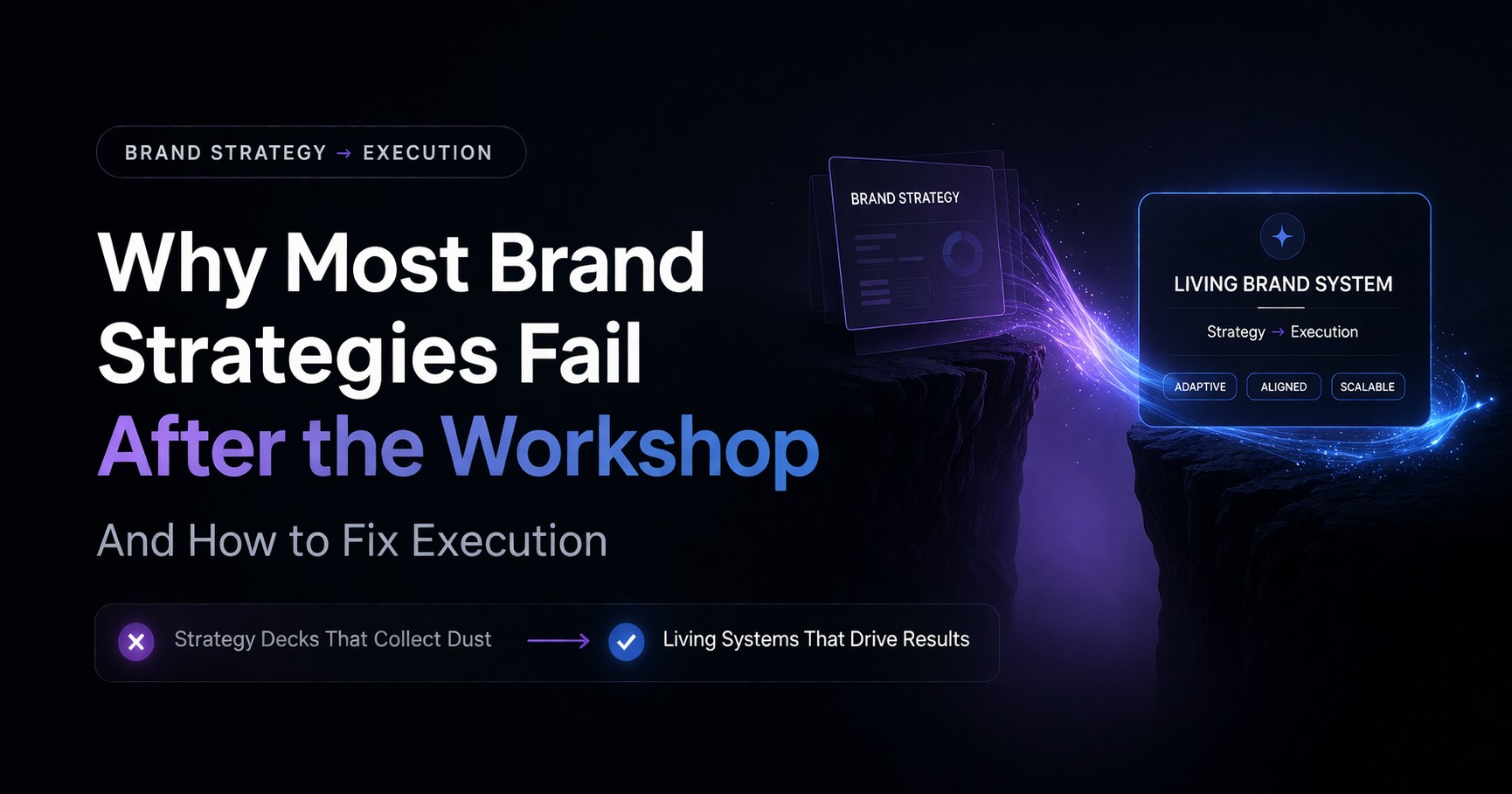
The Beautiful Deck That Changed Nothing
Picture this: You've just wrapped a comprehensive brand strategy workshop. The energy is electric. Your team has spent days distilling your brand's essence into a gorgeous deck—complete with positioning statements, audience personas, value propositions, and a meticulously crafted visual identity system. The final presentation is stunning. Everyone nods in agreement. This is it. This is the foundation that will guide everything forward.
Three months later, that deck sits untouched in a shared drive folder. Your marketing team is creating content that sounds nothing like the voice you defined. Your sales team is pitching value propositions that contradict your positioning. Your social media feels disconnected from your brand strategy. The magic you captured in that workshop room has evaporated, leaving behind only a static artifact that nobody references.
This isn't a failure of vision or creativity. It's a failure of execution. And it's happening to brand strategies everywhere, every single day. The gap between brand strategy creation and brand strategy implementation has become one of the most expensive blind spots in modern business. Understanding why this happens—and more importantly, how to fix it—is the difference between brands that maintain momentum and those that lose their way as they scale.
The Static Strategy Trap: When Documents Replace Systems
The fundamental problem with traditional brand strategy execution lies in its format. We've been conditioned to believe that brand strategy lives in documents—PDFs, slide decks, brand guidelines stored in design tools. These artifacts are treated as the strategy itself, when they're actually just snapshots of strategic thinking frozen in time.
Static documents cannot adapt. They cannot respond to new market conditions, evolving customer feedback, or the inevitable pivots that growing businesses face. A brand strategy deck created in January becomes increasingly disconnected from reality by December. Yet teams continue referencing it as gospel, or worse, they abandon it entirely because it no longer feels relevant.
This static vs dynamic brand strategy problem compounds over time. As your brand evolves, the distance between your documented strategy and your lived reality grows wider. New team members join without understanding the strategic context behind brand decisions. Agencies and contractors receive outdated guidelines. The clarity you achieved in that workshop dissolves into confusion, inconsistency, and a creeping sense that your brand is drifting without direction.
The transformation from static to dynamic requires fundamentally rethinking what brand strategy is. It's not a deliverable—it's a living system. Your brand strategy should function more like an operating system than a reference manual, actively guiding decisions rather than passively documenting them. This shift from brand strategy collecting dust to brand intelligence that drives action is what separates brands that scale with clarity from those that lose their essence in the process.
The Execution Gap: Where Strategic Intent Goes to Die
Even when brand strategies remain relevant, they often fail to translate into actionable execution. This brand strategy vs execution gap manifests in countless painful ways. Marketing teams create campaigns without connecting them to strategic positioning. Designers make visual choices that contradict brand values. Content creators produce material that sounds like everyone else in the market because they're not actively working from a strategic foundation.
The problem isn't that people don't want to execute the strategy. It's that the strategy exists in one place—that beautiful deck—while the work happens everywhere else. There's no bridge between strategic intent and daily execution. Team members would need to constantly reinterpret the strategy, translating high-level positioning into specific content choices, design decisions, and messaging frameworks. That translation work is exhausting, inconsistent, and usually just doesn't happen.
This is why brand strategies fail at the moment they're needed most. When a content creator sits down to write a blog post, they're not thinking about brand strategy—they're thinking about the topic, the audience, and the deadline. When a designer creates a social media graphic, they're focused on visual impact and platform requirements, not strategic alignment. The cognitive load of constantly connecting daily work back to strategic foundations is simply too high.
Successful brand strategy implementation requires removing this translation burden. Strategy must be embedded directly into the workflows where brand expression happens. This means transforming strategic thinking into systems that actively guide content creation, design decisions, and communication choices without requiring constant reinterpretation. The strategy shouldn't be something people reference—it should be something they work within.
The Momentum Problem: One-Time Workshops vs. Continuous Engagement
Traditional brand strategy workshops operate on a flawed assumption: that brand clarity is a destination rather than a journey. You invest significant time and money in a comprehensive workshop, emerge with a complete strategy, and then... execution is supposed to just happen. This one-and-done approach ignores the reality of how brands actually grow and evolve.
Brands are living entities that respond to market feedback, customer insights, competitive shifts, and internal evolution. A positioning statement that resonates today might need refinement six months from now. A brand voice that works for your current audience might need adjustment as you expand into new markets. Brand strategy requires continuous engagement, not periodic overhauls.
The absence of ongoing support and momentum-building mechanisms is why brand strategies often become outdated before they're fully implemented. Teams need continuous reinforcement of strategic thinking, regular touchpoints that reconnect daily work to strategic intent, and systems that help the strategy evolve alongside the business. Without this, even the most brilliant strategy becomes a historical artifact rather than a living guide.
This is where the concept of a living brand system becomes essential. Rather than treating brand strategy as a project with a start and end date, successful brands treat it as an ongoing practice. They create mechanisms for regular strategic review, feedback loops that inform strategic evolution, and systems that maintain alignment even as the brand grows and changes. The workshop isn't the destination—it's the beginning of a continuous process.
The Customization Conundrum: Generic Tools for Unique Brands
Another critical failure point in brand strategy execution is the mismatch between generic tools and specific brand needs. Most content creation and design tools operate without brand context. They offer templates, suggestions, and automation—but none of it is informed by your unique strategic positioning, voice, or values.
This creates a constant tension between efficiency and brand integrity. Teams want to move fast, so they use generic AI tools to draft content or create designs. But those tools produce generic outputs that require extensive editing to align with brand strategy. The promise of automation becomes another source of friction, creating more work rather than less.
Static documents can't adapt to real-time market changes or incorporate feedback dynamically. When customer research reveals new insights about your audience, updating a brand strategy deck doesn't automatically update how those insights inform content creation. When competitive positioning shifts, your brand guidelines don't automatically adjust to maintain differentiation. The strategy remains frozen while the market moves.
What's needed is brand intelligence that's continuously informed by both your strategic foundation and evolving market context. This means systems that understand not just what your brand says, but why it says it—the strategic thinking behind positioning choices, voice decisions, and value propositions. With this deeper intelligence, tools can generate outputs that maintain brand integrity while adapting to new contexts and requirements.
The future of brand strategy execution lies in AI-driven systems that function as strategic partners rather than generic assistants. These systems don't just follow templates—they understand strategic intent and apply it consistently across every brand touchpoint. They maintain the magic of your original vision while enabling the momentum needed to scale.
Transforming Strategy into Action: The Brand Intelligence Approach
The solution to these execution failures isn't better documentation or more detailed guidelines. It's transforming brand strategy from a static artifact into a dynamic intelligence layer that actively guides brand expression across every touchpoint.
This transformation requires three fundamental shifts. First, strategy must become embedded rather than referenced. Instead of living in separate documents that people consult occasionally, strategic thinking needs to be woven directly into the tools and workflows where brand work happens. When someone creates content, the strategy should inform their work automatically, not require manual translation.
Second, brand strategy must evolve from fixed to adaptive. Rather than creating a strategy that remains unchanged until the next big overhaul, successful brands build systems that allow strategy to evolve continuously based on market feedback, customer insights, and business growth. This doesn't mean abandoning strategic consistency—it means maintaining strategic intent while allowing tactical expression to adapt.
Third, execution must shift from interpretation to intelligence. The burden of translating strategy into action shouldn't fall on individual team members trying to remember what was decided in a workshop months ago. Instead, brand intelligence systems should actively apply strategic thinking to specific execution contexts, ensuring consistency without requiring constant reinterpretation.
This is precisely what Eklipsa's Brand Intelligence System enables. By transforming static strategy into dynamic, AI-driven intelligence, we ensure that the clarity and vision captured in your brand strategy workshop doesn't just survive execution—it actively guides it. Your positioning, voice, values, and strategic intent become a living ecosystem that informs every piece of content, every design decision, and every brand expression.
Rather than creating another beautiful deck that collects digital dust, Eklipsa builds a brand intelligence layer that grows with you. As your brand evolves, the system evolves. As you learn more about your audience, that intelligence informs future brand expression. As your market position shifts, your brand strategy adapts while maintaining core consistency. The magic you captured in your original vision doesn't fade—it compounds.
Building Brands That Scale Without Losing Their Soul
The execution gap that causes brand strategies to fail isn't a people problem or a process problem—it's a systems problem. We've been trying to scale brand consistency using tools designed for a different era, when brands were simpler, teams were smaller, and the pace of change was slower. Those approaches no longer work in a world where brands must maintain clarity while moving at the speed of modern business.
The brands that thrive in this environment aren't those with the most comprehensive strategy decks or the most detailed brand guidelines. They're the ones who've transformed strategy from documentation into intelligence—from static reference material into dynamic systems that actively guide brand expression across every touchpoint.
This transformation doesn't diminish the value of strategic thinking—it amplifies it. The insights, positioning, and vision you develop in brand strategy work become more powerful when they're embedded in systems that ensure consistent application. The clarity you achieve becomes compound clarity, building on itself rather than degrading over time.
For founders and brand strategists who care deeply about maintaining momentum without compromising vision, this shift from static strategy to brand intelligence represents a fundamental evolution in how brands are built and scaled. It's the difference between hoping your team remembers what was decided in a workshop and knowing that your strategic intent actively guides every brand expression. It's the difference between fighting to maintain consistency and building systems that ensure it automatically.
Embracing a Living Strategy: Your Next Move
If you recognize your brand in these patterns—if you've watched a brilliant strategy fail to translate into consistent execution, if you've felt the frustration of teams drifting from strategic intent, or if you're tired of brand work that creates beautiful artifacts but doesn't drive real momentum—it's time to reconsider your approach.
Brand strategy shouldn't be something you do once and hope works. It should be a living system that evolves with your brand, guides your team's daily work, and maintains the magic of your original vision even as you scale. This isn't about working harder or creating more documentation. It's about working smarter by transforming strategy into intelligence.
Eklipsa exists to make this transformation possible. We've built a Brand Intelligence System specifically for founders and strategists who need their brand strategy to survive execution without losing clarity. Our AI-driven platform ensures that the vision you define becomes a dynamic ecosystem that guides content, design, and decisions across every stage of growth.
The question isn't whether your brand strategy is brilliant—it probably is. The question is whether it's alive, adaptive, and actively guiding execution. If not, you're leaving the most valuable work you've done trapped in a static format that can't deliver its full potential. It's time to bring your strategy to life.
Transform your brand strategy from a beautiful deck collecting dust into a living intelligence system that drives real results. Because clarity compounds—but only when it's built to last.